
The Moloch Trap: Why We Keep Getting Worse at Relationships and Emotional Health
Breakups and breakdowns are big business

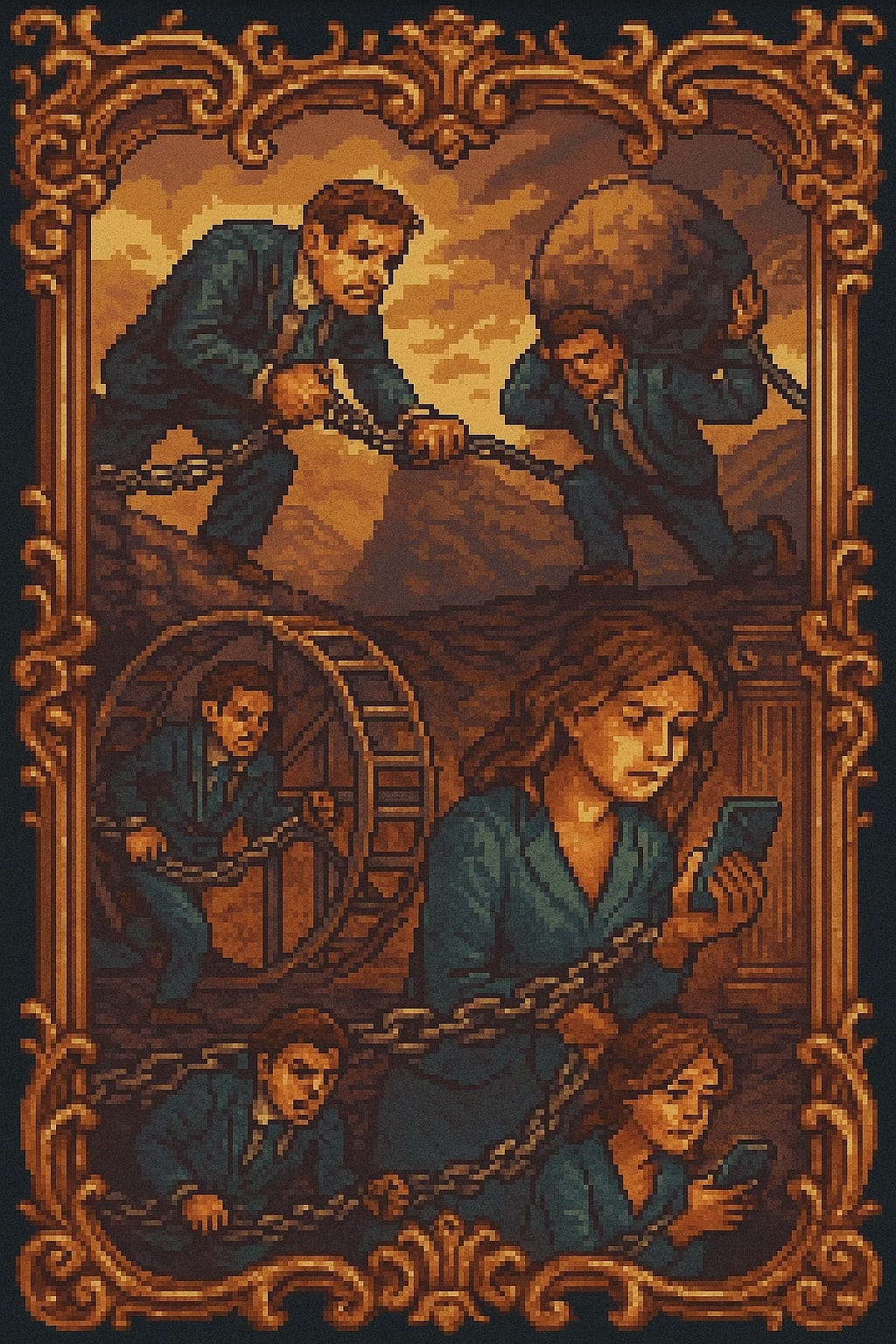
Every social system contains the seeds of its own madness: if optimized too far, and scaled without wisdom, then no one dares to exit.
Let's examine how the unfortunate but well-documented laws that govern so much of humanity's worst impulses perpetuate harmful systems. You can think of the "laws of power" as portraits of human self-preservation instincts run amok without morals. The laws are invoked to show how human insecurities and cognitive shortcuts can lead us into misery.
What is a Moloch Trap?
A Moloch Trap is a self-reinforcing system where individually rational actions lead to collectively disastrous outcomes. It is named after the ancient god Moloch, to whom children were once sacrificed, and revived in modern times as a metaphor for runaway competition and structural perverse incentives. In a Moloch Trap, no single participant desires the collapse, yet all are compelled by the logic of survival to contribute to it.
For context, Scott Alexander first coined the term “Moloch Trap” in his July 30, 2014 blog post “Meditations on Moloch,” using the ancient Canaanite deity as a metaphor for self-reinforcing competitive dynamics that undermine collective well-being (Alexander, 2014).
These traps often emerge in decentralized systems (economic market behavior, dating apps, academia, even everyday social behavior) where optimization for personal gain results in the degradation of shared values: intimacy, creativity, attention, truth. No villain need orchestrate it; no conspiracy is required. Each player simply follows the incentive structure, and together, they summon a monster that results in collective ruin. The tragedy of the Moloch Trap is that exit often demands personal sacrifice and moral courage. Collective restraint is sadly a quality that such systems systematically punish. The trap simply happens (and keeps happening) unless someone breaks the pattern at personal cost.
This is not a new idea. It’s the logic behind the Tragedy of the Commons, the arms race, and runaway AI alignment debates. But it also lives inside our phones, our dating apps, our workplace Slack threads, our art, and even our friendships.
It’s not conspiracy, it’s convergence. Moloch doesn’t need to be loved. Only obeyed.
Below are five modern Moloch Traps, each a slow suicide masquerading as progress.
1. Phubbing: The Cold War of Social Avoidance
Phubbing is a clever combination (or "portmanteau") of “phone” and “snubbing." It means ignoring someone in your physical presence while attending to your phone. It is the socially accepted ritual of defensive social distancing and disconnection.
At first, it’s a nervous reflex. Over time, it becomes a norm. The more people do it, the more awkward it becomes not to.
“Never appear too perfect.”
—Greene, Law 46
This line, while originally about envy, echoes in reverse here: to appear present and emotionally available is now suspicious, vulnerable, “too much.” And so we all look down.
2. Online Dating: The Infinite Swipe Paradox
Everyone seeks connection. Yet the apps we use optimize not for love, but for novelty and game dynamics.
We now “choose” the people we date with the same gestures used to browse shoes. The more options, the less value. The more selection, the less satisfaction.
“What is offered for free is dangerous: it usually involves either a trick or a hidden obligation.”
—Greene, Law 40
What these platforms offer is endless access and attention, not love. It is a perpetual postponement of true authentic intimacy.
3. Content Creation: Post or Perish
Writers, thinkers, and creators are caught in a bind: either churn out regular content to feed the algorithm, or risk disappearing entirely.
Everyone optimizes for clicks, for “engagement,” for visibility. And the result is content that grabs attention but fails to nourish.
“Strike the shepherd and the sheep will scatter.”
—Greene, Law 42
The shepherd in this case is depth. Once it’s removed, everything fragments. Many fear leading with substance, because depth can’t be tracked in analytics; only engagement.
4. Workplace Slack: The Tyranny of Instant Response
Slack was meant to replace the tyranny of email. But instead it replaced boundaries.
Every person who responds instantly sets a new benchmark for “responsiveness.” And so we all perform urgency, regardless of exhaustion or clarity.
“Do not go past the mark you aimed for; in victory, learn when to stop.”
—Greene, Law 47
Slack encourages overshooting. Over-communication becomes the norm. Deep work evaporates. Silence becomes guilt.
5. Academic Publishing: Innovation Strangled by Incentive
To survive in academia, one must publish. But not just publish; publish frequently, and about popular topics that please the right audiences.
This leads to:
Paper-slicing,
Avoidance of controversy,
And sterile repetition.
“Preach the need for change, but never reform too much at once.”
—Greene, Law 45
In academic and social terms: you risk alienation if you upset the wrong person or draw the anger of the crowd. You may be best served by striking out on your own path, rather than pleasing the whims of a capturing audience.
Refusal as Rebellion
To escape a Moloch Trap is to accept short-term disadvantage for long-term dignity. It is to go against the grain of optimization, speed, and safety.
Let others scroll; you hold eye contact.
Let others chase metrics; you craft meaning.
Let others perform productivity; you protect your silence.
For further reading, please see this article which explores Moloch traps in greater detail.
References
Greene, R. (1998). The 48 Laws of Power. New York, NY: Viking Press.
Alexander, S. (2014). Meditations on Moloch. Slate Star Codex.
Przybylski, A. K., & Weinstein, N. (2013). Can you connect with me now? Journal of Social and Personal Relationships, 30(3), 291–310.
Misra, S., Cheng, L., Genevie, J., & Yuan, M. (2014). The iPhone Effect. Environment and Behavior, 48(2), 275–298.
Ostrom, E. (1990). Governing the Commons. Cambridge University Press.
Alexander, S. (2014, July 30). Meditations on Moloch. Slate Star Codex. https://slatestarcodex.com/2014/07/30/meditations-on-moloch/